 How-to
How to Handle Office Catering Allergies: A Safe Guide
Table of Contents
- Start With a Pre-Event Allergy Survey
- Caterer Food Allergy Questions to Ask Before Booking
- Use a Food Allergy Communication Template
- Preventing Cross-Contact in Catering During Setup and Service
- Build a Food Allergy Emergency Plan for Workplace Events
- Event-Day Checklist for Office Catering Allergies
- Frequently Asked Questions
Last Updated: October 16, 2026
Start With a Pre-Event Allergy Survey
Getting allergy details before you book the food is the single most important step in how to handle office catering allergies.
Many offices skip this step. Then someone quietly avoids the buffet all afternoon because they are not sure what is safe. That is the outcome you are trying to avoid.
Food allergies are immune system reactions to specific ingredients (the CDC). Even a trace amount can trigger a serious response in some people.
A pre-event survey is a short form that asks employees about food allergies, dietary restrictions, and dietary preferences before you place a catering order.
What to Ask on the Survey
Keep it short. Long forms get ignored.
- Full name and department
- Do you have a food allergy? If yes, which ingredients?
- Do you follow a dietary restriction or preference?
- How serious is your reaction?
- Do you carry emergency medication?
- Any other notes for the caterer
Add one line stating that answers go only to the event organizer. People share medical details more freely when they know who sees them.
Keeping Responses Confidential
Confidentiality is not optional. A coworker should never learn about another coworker's medical history from a shared spreadsheet.
- Collect responses in a private form, not a group thread
- Share only the allergy list with the caterer, never names
- Store the list in a locked file or password-protected folder
- Delete responses after the event
Caterer Food Allergy Questions to Ask Before Booking
Ask these questions before you sign anything. A caterer who cannot answer them clearly is a risk you do not need to take.
Caterer food allergy questions should cover ingredients, preparation, and service. Get the answers in writing so you can share them with your team.
Here is the list we would send to any caterer:
- Can you provide full ingredient lists for every dish?
- How do you prevent cross-contact between dishes?
- Do you have separate prep areas or utensils for allergen-free items?
- Which dishes can be made without the top allergens?
- How do you label dishes at the serving station?
- What is your process if a guest has a serious reaction?
- Who is the on-site lead we can talk to on event day?
The FDA guidance on food allergens explains which ingredients count as major allergens and why labeling rules exist. Use that list as your baseline when you review a menu.
If a caterer dodges these questions, treat that as your answer. Move on.
Use a Food Allergy Communication Template
A food allergy communication template keeps you from forgetting details when you are juggling a dozen other event tasks. Copy this and fill in the blanks.
Subject: Allergy and Dietary Needs for [Event Name] on [Date]
Hi [Caterer Name],
We have [number] guests with the following needs:
- [Allergy 1]: [number] guests. Severity: [mild / carries medication / severe]
- [Allergy 2]: [number] guests
- Dietary preferences (vegetarian, no cilantro, etc.): [number] guests
Please confirm: 1.
Send this at least a week before the event. That gives the caterer time to adjust the menu and gives you a paper trail.
Preventing Cross-Contact in Catering During Setup and Service
Preventing cross-contact in catering comes down to separation at every handoff: prep, transport, setup, and service. The CDC information on food allergies notes that even small amounts of an allergen can cause a reaction in sensitive people, which is why the setup matters as much as the recipe.
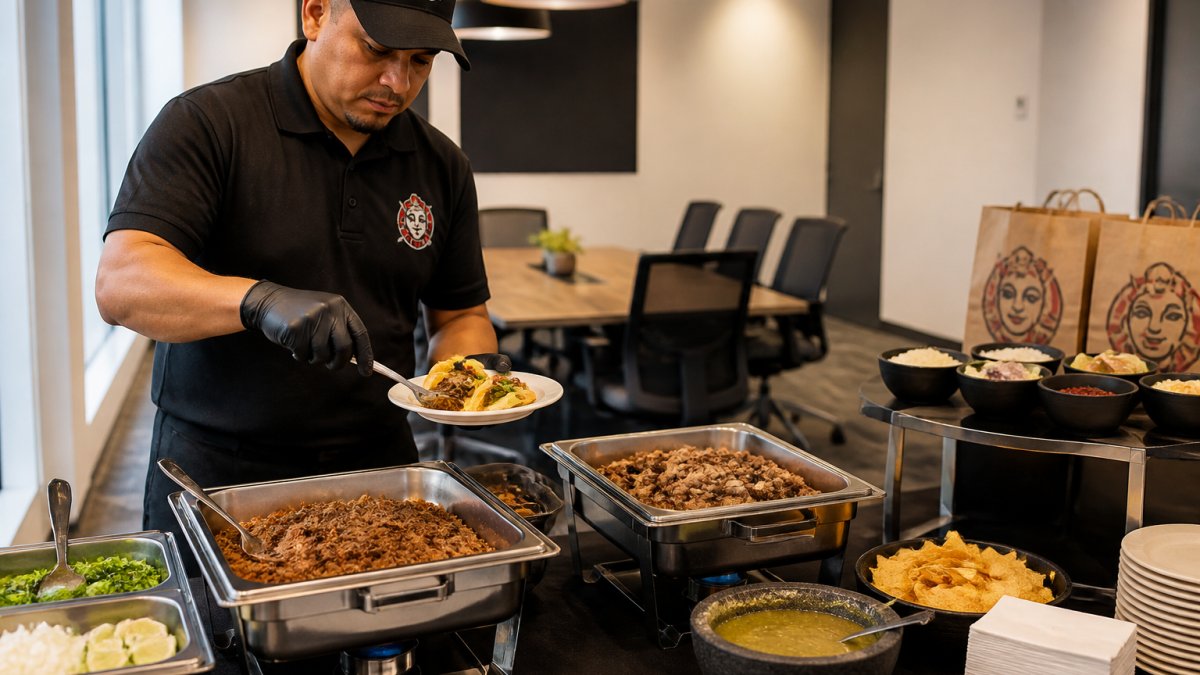
Where Cross-Contact Actually Happens
Most organizers think about the buffet line. The risk usually starts earlier.
- Prep surfaces. A cutting board, a shared fryer, or a grill used for a marinated item can carry allergen residue into a "safe" dish. Ask whether allergen-free items are prepared first, on cleaned equipment, or in a separate area.
- Transport. Stacked trays, shared lids, and a single cooler let drips and crumbs move between dishes. Request that allergen-free items travel in sealed, labeled containers on a separate tray.
- Setup. The same gloved hand that arranges a cheese platter can transfer residue to a fruit tray. Have the caterer set allergen-free dishes first, then change gloves.
- Service. A spoon that touches one dish and then another is the most common source of cross-contact at an office buffet.
- Garnish and condiments. A shared salsa, a sprinkle of cheese, or a single garnish bowl can undo an otherwise safe dish. Ask for condiments in individual or clearly labeled containers.
Buffet and Serving Station Rules
Set these rules before guests arrive, and brief whoever is running the line.
- Keep allergen-friendly dishes on a separate table when possible
- Give each dish its own serving utensil, and never swap them
- Place allergen-free items first in the line so they are not touched by other spoons
- Use clear signage on every dish listing the top allergens present
- Ask the caterer to refresh utensils midway through service
- Keep the buffet area clean and free of stray crumbs
- Ask servers to change gloves between handling allergen-free and other dishes
If you cannot separate a dish, label it clearly instead. A guest who knows what is in a dish can make their own call.
When a Caterer Cannot Verify a Dish
Sometimes a caterer cannot confirm that a dish is free of a specific allergen. That is not a failure, it is information. Use this decision order:
- Ask for a substitution. Many caterers can swap a sauce, remove a garnish, or prepare a portion without the allergen.
- Request a packaged alternative. A sealed, labeled single-serving item from a store is easier to verify than a dish prepared in a shared kitchen.
- Choose a different meal option. If neither works, arrange a separate meal for the affected guest rather than guessing.
- Document the decision. Note what was offered and what the guest chose, so you can improve the next order.
Never ask a guest to "just pick around" an allergen. That is not a safety plan.
Build a Food Allergy Emergency Plan for Workplace Events
A food allergy emergency plan for workplace events is a short written plan that tells everyone what to do if someone has a reaction. It takes ten minutes to write and it can save a life.
Anaphylaxis is a severe, fast-moving allergic reaction that can affect breathing and blood pressure. It needs immediate medical help. Symptoms can include hives, swelling of the face or throat, trouble breathing, a drop in blood pressure, or a feeling that something is very wrong.
Assign Roles Before the Event
A plan without named people is a wish. Fill in these roles on the morning of the event and tell each person what they own.
- Designated responder. One person who stays with the guest, keeps them calm, and helps them use their own medication if they carry it. This person does not leave to find help.
- Caller. One person who calls 911, gives the address and the situation, and stays on the line. Do not assume someone else is calling.
- Greeter. One person who meets emergency services at the entrance and leads them to the guest. In a large office or event space, this saves critical minutes.
- Organizer. One person who knows which guests disclosed allergies and can confirm what was served.
Catering staff are not medical providers. Do not assign them a responder role. Their job is to stop service if needed and answer questions about ingredients.
Locate Medication and Information
If a guest voluntarily discloses that they carry emergency medication, ask where they keep it and who else knows. Do not handle or administer someone else's medication unless they ask you to and you are trained. The goal is to make sure the medication is reachable in seconds, not minutes.
Keep a printed copy of the plan at the event, not just on someone's phone. Include:
- The street address of the venue, written out, for the 911 call
- The closest hospital and the fastest route
- The names of the designated responder, caller, and greeter
- A note that the guest's own medication may be on their person
Run a Two-Minute Briefing
Before guests arrive, gather the assigned team and walk through the plan out loud. Ask each person to say their role back to you. This takes two minutes and catches the most common failure: everyone assumes someone else is the caller.
After a Reaction or a Near Miss
If a reaction or a near miss happens, write down what occurred, what was served, and how the response went. Share it with the caterer and your team. That record is how the next event gets safer.
Event-Day Checklist for Office Catering Allergies
Run through this list on the morning of the event. It takes five minutes.
| Step | Action | Timing |
|---|---|---|
| 1 | Confirm final headcount and allergy list with the caterer | Morning of |
| 2 | Print dish labels and signage | Before setup |
| 3 | Check that allergen-free dishes are separated | At setup |
| 4 | Verify each dish has its own utensil | At setup |
| 5 | Brief staff on the emergency plan | Before guests arrive |
| 6 | Walk the buffet line and spot-check labels | Before service |
| 7 | Keep the allergy list on hand during service | Throughout |
| 8 | Collect feedback after the event | Same day |
That last row matters more than it looks. Ask guests with allergies how the meal went. Their answers tell you what to fix next time.
At Tacos Papi Grande, we build every catering order around the allergy details you send us.
Handling office catering allergies is not about finding one perfect caterer.
Tacos Papi Grande makes that process easier. We are a 501(c)(3) nonprofit, so a portion of every order goes back into the community to help single parents in need.
Frequently Asked Questions
How should an office handle food allergies when ordering catering?
Start by sending a short pre-event survey to everyone attending, asking about food allergies and dietary restrictions. Share the results with your caterer at least a week before the event so they can plan safe menu items. Ask the caterer to label each dish clearly and provide separate serving utensils. On event day, set aside allergen-friendly dishes at their own station and keep the ingredient list visible so employees can check before they eat.
What should you ask a caterer about food allergies?
Ask whether they can identify all ingredients in each dish, including sauces and garnishes. Find out how they prevent cross-contact during preparation and service, such as using separate cutting boards, pans, and utensils. Ask if they can prepare allergen-friendly portions first or in a separate area. Confirm whether they will label each dish and provide a written ingredient list. If they cannot verify ingredients or safety steps, treat that as a red flag and look for another option.
How can you prevent cross-contact at a catered office lunch?
Preventing cross-contact in catering starts with the setup. Give allergen-friendly dishes their own table, their own utensils, and clear signage. Keep shared condiments and toppings in sealed containers rather than open bowls where spoons get swapped. Ask the caterer to use clean gloves and separate tools when plating. If the buffet line is self-serve, place allergen-friendly items first so hands and tongs do not travel from one dish to another before reaching them.
What should you do if an employee has an allergic reaction at a catered event?
Call 911 immediately if the person has trouble breathing, swelling, or a rapid pulse. If they carry an epinephrine auto-injector, help them use it while waiting for emergency services. Keep the person sitting upright and calm, and do not let them eat or drink anything else. After the event, document what happened, which dish was involved, and what steps were taken. Review your food allergy emergency plan for workplace events and adjust it before the next catering order.