 How-to
How Do You Find Caterers for Food Allergy Accommodations?
Last Updated: November 19, 2026
Quick Summary
Finding caterers for food allergy accommodations starts with one honest conversation before you sign anything, naming every allergen and how many guests each one affects. Strong food allergy catering depends on asking about ingredient sourcing, kitchen procedures, and written cross-contact controls. Get the safe meals, labeling, and day-of escalation plan confirmed in writing.
- Share every allergen, guest count per allergen, severity, and emergency medication before booking.
- Ask caterers for full ingredient lists, brands, and labels for marinades, sauces, and spice blends.
- Request a written allergy meal workflow covering separate prep area, dedicated equipment, and labeling.
- Plated meals offer the highest safety control; self-serve buffets carry the lowest.
- Name one allergy contact on each side and default to a guest waiting for a confirmed safe plate.
Table of Contents
- Start Early: Communicating Allergy Needs Before You Book
- Food Allergy Catering Questions to Ask Every Caterer
- Caterer Cross-Contact Prevention: What to Verify
- Use a Food Allergy Catering Request Template
- Allergy-Aware Buffet Setup and Service Styles
- Comparing Catering Options and Their Trade-Offs
- Written Agreements, Costs, and Day-of Escalation Plans
- Book Allergy-Aware Taco Catering for Your Next Event
- Frequently Asked Questions
Start Early: Communicating Allergy Needs Before You Book
Finding caterers for food allergy accommodations starts with one honest conversation, and it should happen before you sign anything. The earlier a host shares allergy details, the safer the whole event becomes.
Food allergy catering works best when the caterer knows the full picture up front. That means naming every allergen, not just the big ones. Peanut allergy and tree nut allergy get most of the attention, but dairy allergy, soy allergy, and celiac disease matter just as much.
A common mistake is waiting until the week of the event. Kitchens plan menus and order ingredients days in advance. Late notice shrinks your options.
Here is what to share in that first message:
- Every allergen and dietary restriction in the group
- How many guests each one affects
- Whether the reaction is mild or severe
- Any guest who carries emergency medication
Food allergy guidance from the CDC notes that reactions can range from mild to life-threatening, so treat every disclosure as serious. For a deeper walkthrough, see our guide on how to handle office catering allergies.
Food Allergy Catering Questions to Ask Every Caterer
The right questions separate a caterer who understands allergies from one who just nods along. Ask these before you book.
Questions About Ingredients and Sourcing
Ingredient sourcing is where hidden allergens live. Sauces, marinades, and spice blends often carry soy, dairy, or gluten that nobody expects.
Ask directly:
- Can you share a full ingredient list for every dish?
- Which brands do you buy, and can I see labels?
- Do any marinades or salsas contain soy, dairy, or gluten?
- How do you handle recipe changes when a guest has multiple allergies?
If a caterer cannot answer these, keep looking. For more on vetting, read managing food allergies for corporate catering events.
Questions About Kitchen Procedures and Staff Training
Kitchen procedures matter as much as ingredients. A clean ingredient can still pick up allergens during food preparation.
Ask how staff are trained on allergen handling. Ask who on the team owns allergy requests on event day. Ask whether allergy-aware staff work the line or just the office.
Caterer Cross-Contact Prevention: What to Verify
Cross-contact prevention is the difference between a safe meal and a sick guest. Cross-contact happens when allergens transfer through shared equipment, shared surfaces, or shared serving utensils. Most caterers will say they "handle allergies," but the verification step is where hosts separate real procedures from reassuring language.
Ask for a walkthrough of the kitchen workflow, not just a list of controls. A credible caterer can describe the sequence from storage to plating for an allergy meal. Ask whether the caterer uses a separate preparation area, dedicated equipment, covered storage with labeling, and a cleaning step between tasks.
Watch out: a caterer who says "we clean everything" without naming a separate prep area may not have a defined process. Ask for specifics: Which surface is used? Which tools are dedicated? Who performs the cleaning check?
A practical way to assess cross-contact controls is to ask for a written description of the allergy meal workflow. Request that the caterer confirm, in writing, the separate prep area, dedicated equipment, and labeling method. If they cannot put it in writing, treat that as a warning sign.
For buffet service, ask whether allergy meals are plated in the kitchen and kept covered until service, rather than placed on the main line. Ask whether serving utensils for allergy dishes are stored separately and whether staff will plate those dishes rather than allowing self-service.
If gluten is a concern for your group, review gluten-free taco catering options for what to look for.
Use a Food Allergy Catering Request Template
A written request removes guesswork. Use this food allergy catering request template when you contact any caterer:
Event date and time: Guest count: Service style: buffet / plated meal / family style Allergens present in the group: peanut, tree nut, dairy, soy, gluten, shellfish, egg, other Guests per allergen: Severity level for each guest: Dietary requirements beyond allergies: vegetarian, vegan, halal, other Requested safe alternative meals: On-site contact name and phone: Deadline to confirm arrangements:
Send this in writing and ask the caterer to confirm each line. Keep the reply. A written record protects your guests and your team.
Allergy-Aware Buffet Setup and Service Styles
Buffet service carries more risk than a plated meal, because guests serve themselves and utensils travel between dishes. Allergy-aware buffet setup fixes most of that.
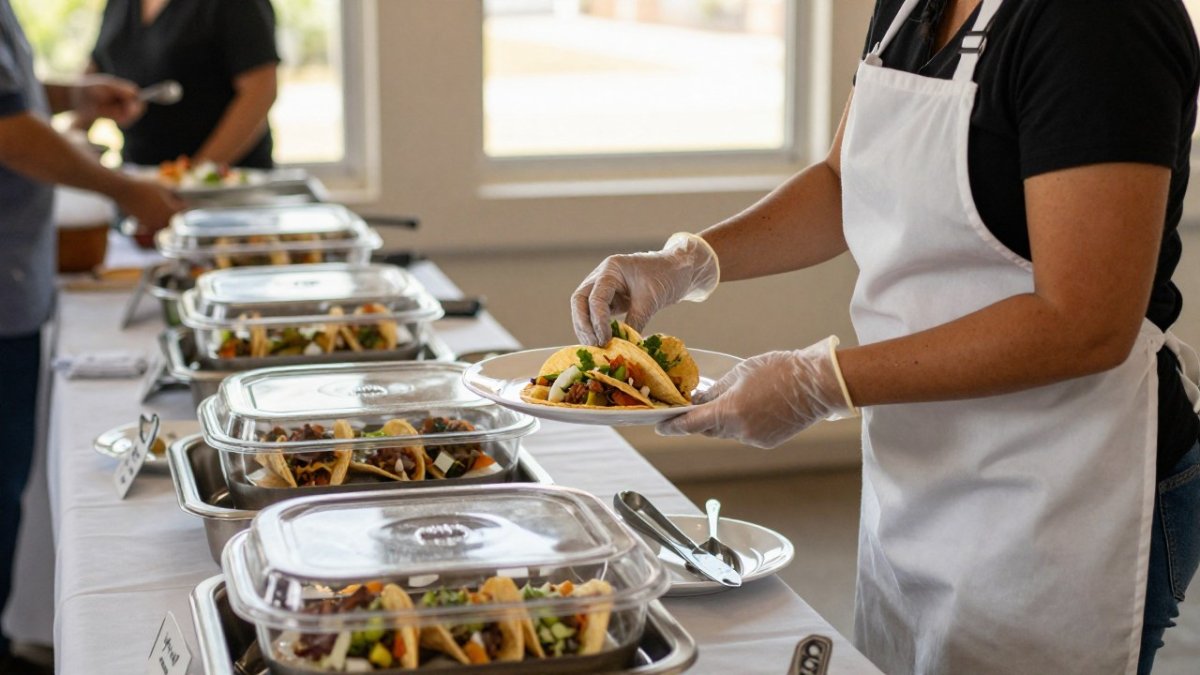
Common setups include plated meals, served buffets, and separate stations, depending on the event.
Food labeling matters in every setup. Label each dish with its full ingredient list, not just a name. A guest with a soy allergy cannot guess from "house salsa."
Comparing Catering Options and Their Trade-Offs
Every service style trades cost and convenience against control. Here is how the main options stack up.
| Option | Safety Control | Cost Level | Best For |
|---|---|---|---|
| Plated meal | Highest | Highest | Severe allergies, formal events |
| Served buffet | High | Medium | Workplace catering, mid-size groups |
| Self-serve buffet | Lowest | Lowest | Low-risk groups only |
| Drop-off catering | Varies | Low | Small teams with mild restrictions |
| On-site cooking | High | Medium to high | Large events needing fresh food |
For a side-by-side look at menu choices, see allergen-friendly office lunch catering options.
Written Agreements, Costs, and Day-of Escalation Plans
Get the allergy plan in writing. A verbal promise is not a plan, and a written record protects your guests and your team if something goes wrong.
Your agreement should confirm:
- The exact safe alternative meals and who receives them, by guest name or identifier
- How dishes will be labeled, including the full ingredient list and allergen statement
- Who the on-site allergy contact is for both the caterer and your group
- What happens if a dish runs out, a recipe changes, or a substitute ingredient is used
- The deadline for final guest counts and allergy disclosures
Use a simple written confirmation format. After the caterer replies to your request template, ask them to reply with a line-by-line confirmation of each item. Keep that reply with your event file. If the caterer will not confirm in writing, that is a signal to keep looking.
Budget, fees, and minimums for allergy accommodations vary by caterer. Pricing depends on quantity, dates, delivery, and service style, so ask for a written quote rather than guessing. Specific questions to ask:
- Is there an extra fee for separate allergy meals or a dedicated prep area?
- Does the order minimum apply to the total order or to the allergy meals separately?
- Are there delivery or setup fees that change with the number of separate meals?
- What is the cancellation or change policy if guest counts or allergy needs change?
Build a day-of escalation plan too. Name one person on your side and one on the caterer's side. Agree on a signal for a guest who cannot confirm a dish is safe. The default should be that the guest waits for a confirmed safe plate. No exceptions. A delayed plate beats a hospital trip.
If a safe meal cannot be provided, the escalation plan should say who decides and what the backup is. Write that backup into the agreement so no one is improvising on event day.
Book Allergy-Aware Taco Catering for Your Next Event
The work you do before the event is what keeps guests safe during it. Early communication, sharp questions, verified cross-contact controls, and a written plan cover almost every gap.
At Tacos Papi Grande, we cook scratch-made birria, al pastor, and asada. We offer free delivery for groups of five or more and on-location cooking for parties of 50 or more. As a 501(c)(3) nonprofit, a portion of proceeds is reinvested into our local community to assist single parents in need.
Ready to plan a menu that works for everyone at the table? Book allergy-aware taco catering and tell us about your guests first.
Your guests trust you to get this right, and one careful conversation with your caterer does most of the work. Tacos Papi Grande builds every allergy request into the menu from the start, with scratch-made dishes, free delivery for groups of five or more, and full on-site cooking for larger parties. Get started with Tacos Papi Grande and serve a meal every guest can enjoy.
Frequently Asked Questions
What should I ask a caterer about food allergies?
Ask how they handle ingredient sourcing, whether they keep written ingredient lists, and how they prevent cross-contact in the kitchen. Request details on staff training, separate preparation areas, and dedicated serving utensils. Ask whether they can provide a safe alternative or separate meal for each guest with a food allergy, and get the answers in writing. A caterer who answers vaguely or promises a dish is completely allergen-free is a warning sign.
Are caterers required to provide allergen information?
Food safety requirements for allergens vary by state and local jurisdiction, so confirm the rules with your local health department. Ask your caterer for their written allergen procedures.
Can a caterer guarantee that a meal is allergen-free?
No reputable caterer can guarantee a dish is completely free of a specific allergen unless it comes from a dedicated allergen-free facility. Shared kitchens, shared equipment, and ingredient sourcing make absolute guarantees unrealistic. Instead, look for a caterer who is honest about cross-contact risks, uses a separate preparation area, and confirms safe alternatives in writing. That transparency is a better sign of a reliable food allergy catering partner than a blanket promise.
How can a buffet be set up to reduce food-allergy risks?
An allergy-aware buffet setup uses labeled dishes with full ingredient lists, dedicated serving utensils for each item, and a separate station for allergen-safe options. Keep dishes covered when possible, place allergen-containing items away from safe dishes, and have staff serve high-risk items rather than guests self-serving. Assign one staff member to monitor the line and answer guest questions. For severe allergies, a plated meal served directly to the guest is safer than a buffet.